
The Costa Daurada is known for its beaches, coastal towns and Mediterranean landscapes, but its heritage offers many more reasons to explore the region. Among historic cities, medieval towns and small inland villages, you will find churches, cathedrals, sanctuaries and monasteries that provide an insight into an essential part of the history of Tarragona and its surroundings.
Some of these buildings stand out for their architecture, while others form part of monumental complexes linked to key moments in Catalan history. Tarragona Cathedral, the monasteries of Poblet and Santes Creus, and the Montferri Sanctuary are some of the places that best represent this diversity.
Exploring these sites is a different way to discover the Costa Daurada, combining heritage, culture and landscape beyond the coastline.
You can book your transfer to the Costa Daurada with ShuttletoSun. The shared transfer services and private transfer services, affordable and sustainable, allow you to travel to the Costa Daurada from Barcelona Airport, Barcelona Port, Girona Airport, Reus Airport and Camp de Tarragona AVE train station.
Tarragona Cathedral, one of the great symbols of the Costa Daurada
Among the churches of the Costa Daurada worth visiting, Tarragona Cathedral holds a prominent place. Located in the highest part of the old town, construction began in the 12th century and the cathedral was consecrated in 1331. Its architecture reflects the transition from Romanesque to Gothic style and is one of the main examples of the city’s medieval past.
The complex includes the cathedral, the cloister and the Diocesan Museum, allowing visitors to discover both the building itself and various examples of religious art. Its location also makes it easy to combine a visit with a walk through Tarragona’s historic centre and other remains of ancient Tarraco.
The city also preserves other sites connected with the history of Christianity, such as the chapel of Santa Tecla la Vella and the church of Santa Maria del Miracle.
Poblet and Santes Creus, the religious heritage of the Cistercian Order
The religious heritage of the Costa Daurada cannot be understood without its monasteries. Poblet and Santes Creus, both part of the Cistercian Route, offer an opportunity to discover the importance these religious communities had in the history of the region.

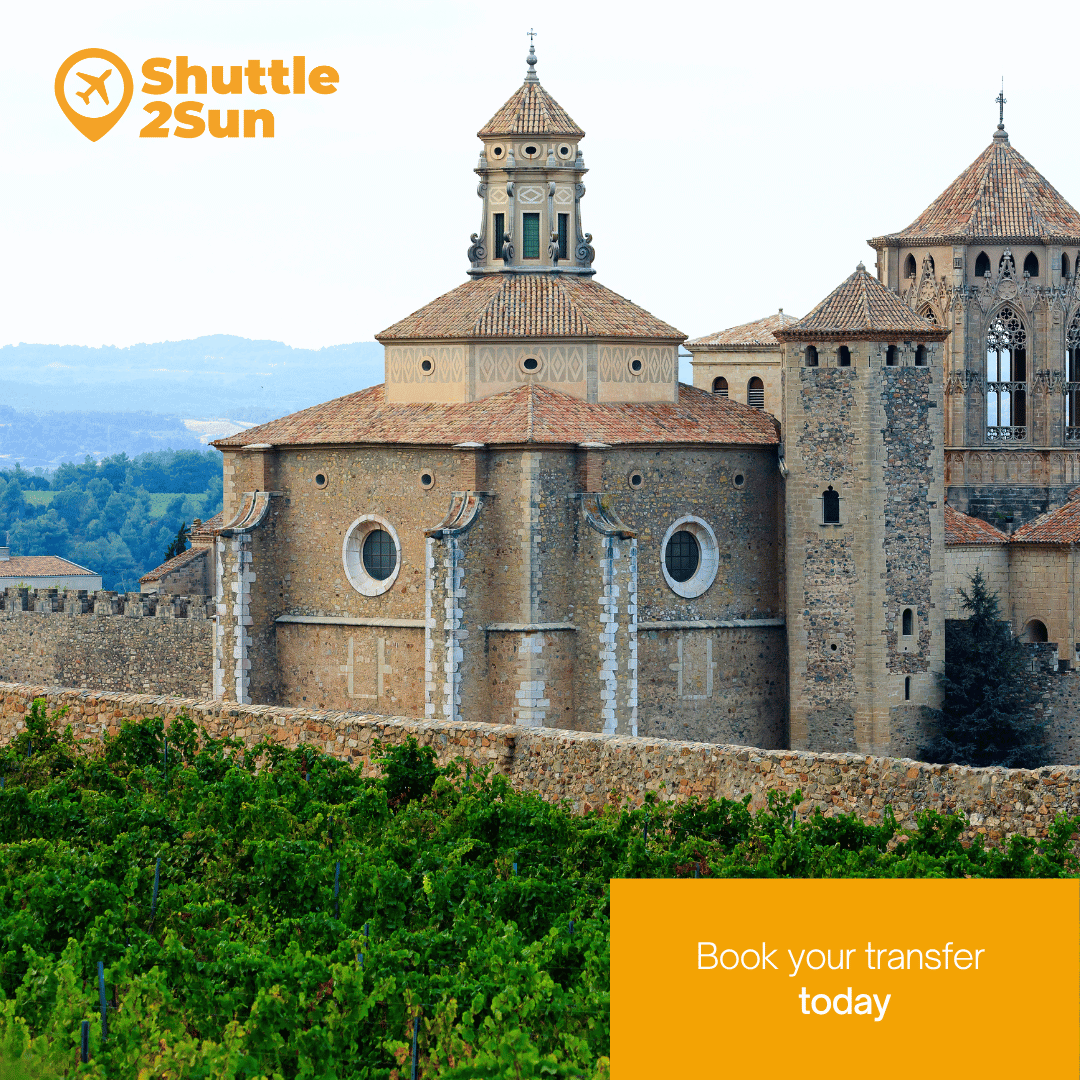
The Royal Monastery of Santa Maria de Poblet stands out for the scale of its architectural complex and for still being home to a community of monks. The monastery was protected by the rulers of the Crown of Aragon and became a royal pantheon. It is also part of the UNESCO World Heritage.
Santes Creus offers another perspective on Cistercian heritage. Its complex preserves the church and various monastic spaces, particularly its Gothic cloister. Inside the church, visitors can also find the tomb of Pere the Great, one of the most notable features of the visit.
Both monasteries are a good option for those who want to combine a getaway to the Costa Daurada with a cultural excursion into the inland areas.
Don’t forget to book your transfer to the Costa Daurada with ShuttletoSun. The shared transfer services and private transfer services allow you to travel to the Costa Daurada from Barcelona Airport, Barcelona Port, Girona Airport, Reus Airport and Camp de Tarragona AVE train station.
Montferri Sanctuary and Jujol’s architecture
One of the most unique religious buildings in the area is the Montferri Sanctuary. Its design was created by architect Josep Maria Jujol, who was closely associated with Catalan modernism and collaborated with Antoni Gaudí.
The sanctuary was conceived as a tribute to the Virgin of Montserrat, and its distinctive structure, inspired by natural forms and the mountain itself, clearly sets it apart from the medieval churches found throughout the area. Its silhouette and location make a visit an opportunity to combine architecture and landscape.
It is also a good example of how the religious heritage of the Costa Daurada is not limited to ancient buildings, but also includes examples of architecture associated with modernism.
Medieval churches in Montblanc
Religious heritage also has an important presence in Montblanc, one of the best-known medieval towns in the province. Its historic centre preserves churches and other buildings that allow visitors to explore different stages of its past. Among them is the Church of Santa Maria, located within the walled enclosure. Its presence is closely linked to the town’s medieval heritage,
making it particularly interesting to visit alongside a walk through its streets and along its walls. Montblanc therefore offers a different experience from Tarragona: here, religious heritage is integrated into a medieval urban landscape where churches, palaces and walls form part of the same route.
How to discover the churches of the Costa Daurada
A route through the churches of the Costa Daurada can easily be adapted to the time available and combined with other attractions in each town. Tarragona is a good option for a first introduction, as you can visit its Cathedral while also exploring the city’s Roman and medieval heritage. For a more complete excursion, Poblet and Santes Creus offer the chance to discover the history of the Cistercian Order up close, while Montferri stands out for its unique modernist architecture.
It is advisable to check opening hours before visiting each place of worship, especially when they continue to serve a religious function. It is also worth taking time to explore the surroundings of each monument, as many are located close to historic towns, natural areas and places where you can enjoy the local cuisine.
The churches of the Costa Daurada reveal a side of the region that goes beyond its beaches. Cathedrals, monasteries and sanctuaries allow visitors to discover different stages of its history and complete a getaway in which heritage, culture, nature and coastline can all form part of the same journey.
You can book your transfer to the Costa Daurada with ShuttletoSun. The shared transfer services and private transfer services, affordable and sustainable, allow you to travel to the Costa Daurada from Barcelona Airport, Barcelona Port, Girona Airport, Reus Airport and Camp de Tarragona AVE train station.