The Iberian Route in Catalonia offers the opportunity to discover the remains of the communities that inhabited this territory before Romanisation. Through ancient settlements, fortifications and museums, visitors can learn how these people lived, how they organised their societies and how they interacted with the Mediterranean landscape.
Coordinated by the Museu d’Arqueologia de Catalunya (Archaeology Museum of Catalonia), this cultural initiative brings together several archaeological sites spread across the region. From Ullastret, in the Empordà, to Calafell and the Terres de l’Ebre, each site offers a different perspective on Iberian culture. The route also provides an opportunity to discover natural surroundings, historic villages and gastronomic traditions that enrich the experience.
If you are looking for a different kind of cultural getaway, this route is a great way to combine history and tourism in Catalonia. You can book your transfer from Barcelona Airport to the Iberian Route in Catalonia with ShuttletoSun. Our shared shuttle services and private transfer services, which are affordable and sustainable, allow you to travel to the route from Barcelona Airport, Barcelona Port, Girona Airport, Reus Airport and Camp de Tarragona AVE train station.
What is the Iberian Route in Catalonia?
The Iberian Route is a cultural tourism project created to promote the archaeological heritage of the Iberian communities. It brings together around thirty archaeological sites and museums, organised into different itineraries that allow visitors to explore the territories inhabited by these ancient peoples.
Iberian culture developed in Catalonia between the 6th and 1st centuries BC. It was not a uniform civilisation but rather consisted of different communities, including the Indiketes, the Laietani, the Cessetani and the Ilergetes. Each occupied its own territory and developed distinct forms of social organisation.
Archaeological remains reveal what their homes looked like, which economic activities they practised and how they interacted with other Mediterranean peoples. The walls, streets and objects uncovered during excavations are essential to reconstructing their history.
Ullastret, one of the great Iberian cities
In the Baix Empordà region lies Ullastret, one of Catalonia’s most remarkable archaeological sites. The settlement of Puig de Sant Andreu was an important centre of the Indiketes and preserves remains of walls, defensive towers, houses and public spaces.

Excavations have also uncovered evidence of temples and cisterns, features that reveal the complexity of its urban organisation. Its inhabitants engaged in agriculture and livestock farming, made use of local resources and maintained commercial exchanges with neighbouring communities and other Mediterranean peoples through Empúries.
Visiting the archaeological site and its dedicated museum helps put these discoveries into context and understand how the settlement developed over time. Its location also makes it possible to combine the visit with a journey through the landscapes and historic villages of the Empordà.
The Iberian Citadel of Calafell
The Iberian Citadel of Calafell, located on the Costa Dorada, stands out for its partial reconstruction using experimental archaeology techniques. This work helps visitors visualise what some of the settlement’s structures may have looked like and better understand how its different spaces were organised.
During the visit, you can see reconstructed houses and defensive features that make the archaeological remains easier to interpret. It is a particularly interesting experience for anyone who wants to discover everyday Iberian life in a visual and educational way.
Its location in Calafell also allows visitors to combine this cultural experience with other attractions in the municipality, such as local heritage, the seafront promenade and Mediterranean cuisine.
Remember that you can book your transfer to the different sites along the Iberian Route with ShuttletoSun. Our shared shuttle services and private transfer services allow you to travel to the Iberian Route from Barcelona Airport, Barcelona Port, Girona Airport, Reus Airport and Camp de Tarragona AVE train station.
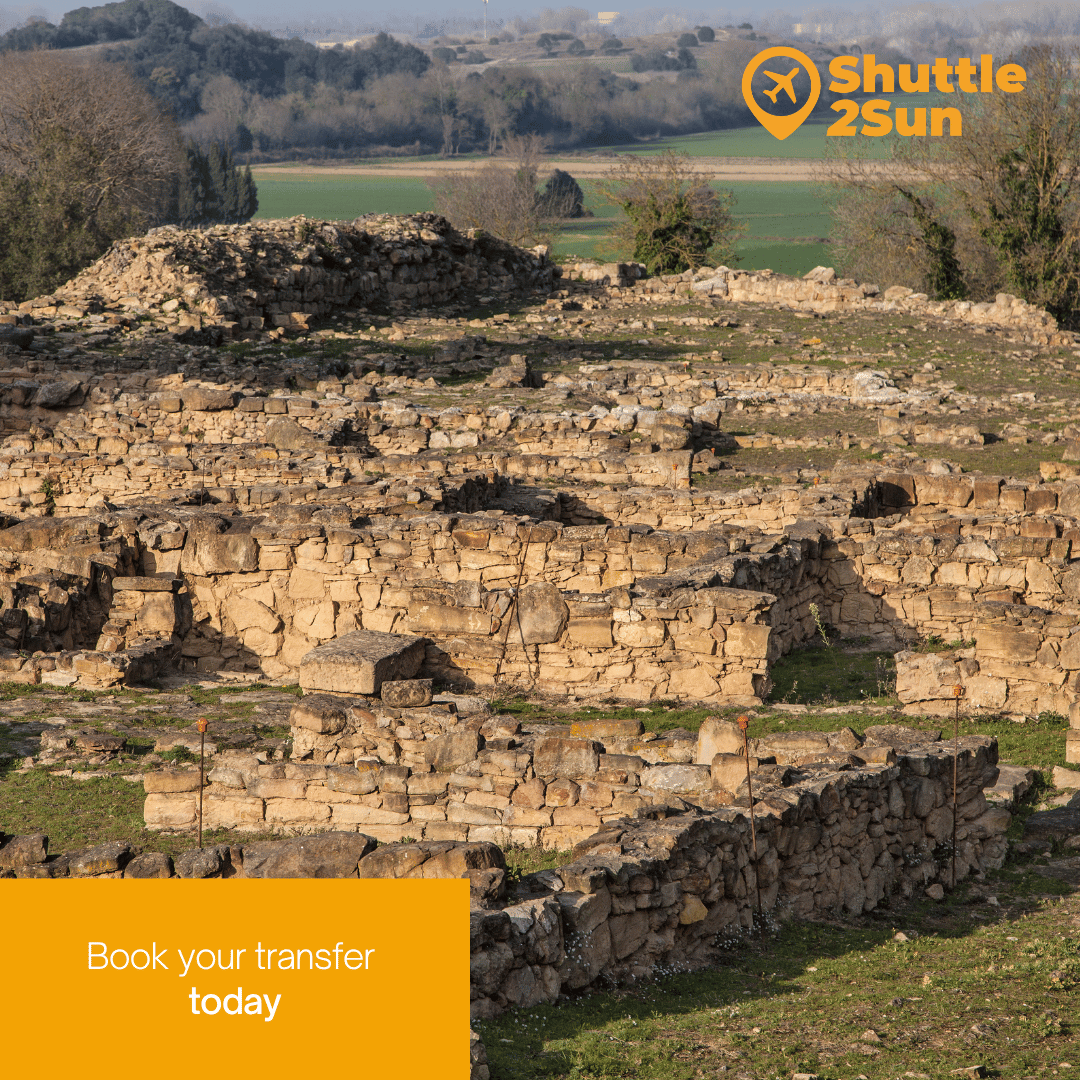
Castellet de Banyoles, beside the River Ebro
In Tivissa, in the Ribera d’Ebre region, lies Castellet de Banyoles, an Iberian settlement built in a strategic position overlooking the Móra Basin and the surrounding area of the River Ebro.
Its location helps visitors understand the importance of territorial control and communication routes in ancient societies. Among its most distinctive features are two pentagonal towers, which formed part of the settlement’s defensive structures.
The site is also associated with the Tivissa Treasure, a collection of silver objects dating back to the Iberian period. Visiting this archaeological site offers an opportunity to explore the heritage of the Terres de l’Ebre and discover the inland landscapes of Tarragona.
Other Iberian settlements worth discovering
The route includes numerous sites that allow you to extend your journey. In Santa Coloma de Gramenet, Puig Castellar preserves the remains of a settlement located on a hill in the Serralada de Marina mountain range. Its position illustrates how many settlements took advantage of elevated terrain to keep watch over their surroundings.
In Cerdanyola del Vallès, the Ca n’Oliver archaeological complex combines an
ancient settlement with a museum dedicated to Laietani culture. Meanwhile, Molí d’Espígol, in Tornabous, stands out for its urban layout and its connection with the Ilergetes.
The route also includes Darró, in Vilanova i la Geltrú, where the remains of a Cessetani Iberian settlement have been preserved. The diversity of these sites shows that Iberian heritage is not concentrated in a single region but can be found throughout different parts of Catalonia.
Discover Catalonia’s Iberian heritage
The Iberian Route in Catalonia offers a different way to explore the region through its ancient cities, fortifications and museums. Each archaeological site provides valuable information about the communities that once inhabited these lands and helps visitors better understand their relationship with the landscape, trade and Mediterranean societies.
Plan your itinerary according to your interests and make the most of your visit by discovering the villages and natural surroundings of each region. To organise your journey comfortably, you can book your transfer to the Iberian Route in Catalonia with ShuttletoSun. Our shared shuttle services and private transfer services allow you to travel to the route from Barcelona Airport, Barcelona Port, Girona Airport, Reus Airport and Camp de Tarragona AVE train station.