
When thinking of Vila-seca and La Pineda, it is easy to picture their beaches, seafront promenade and Mediterranean atmosphere on the Costa Daurada. However, behind this coastal image lies a historical heritage that offers a glimpse into a much older side of the area. Castles, defensive towers, former walls, buildings linked to agriculture and religious sites form a heritage ensemble that connects the medieval past of Vila-seca with the development of La Pineda and its surroundings.
Exploring this heritage is also a different way to discover the municipality. Some of its most important sites are located in the historic centre of Vila-seca, while others are linked to the former agricultural landscape and the area close to the coast. Among them are defensive structures built to protect the local population, buildings associated with wine production and places that preserve local traditions and legends.
If you want to discover this heritage at your own pace from the moment you arrive, you can book your transfer from Barcelona Airport to Vila-seca and La Pineda with ShuttletoSun. The shared transfer services and private transfer services, affordable and sustainable, allow you to travel to Vila-seca and La Pineda from Barcelona Airport, Barcelona Port, Girona Airport, Reus Airport and Camp de Tarragona AVE train station.
Vila-seca Castle, One of the Great Treasures of the Local Heritage
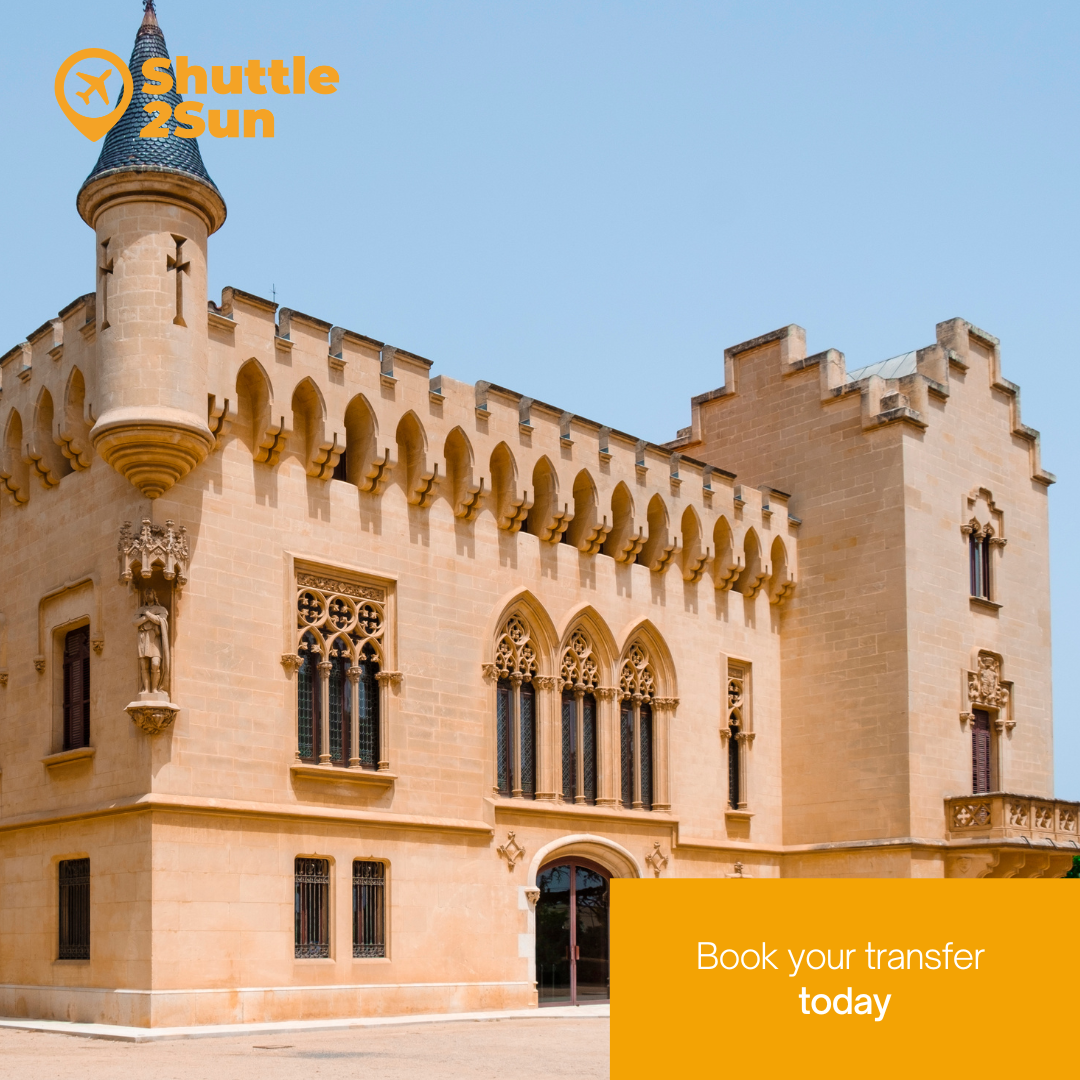
One of the main landmarks of the historical heritage of Vila-seca is its castle. Its origins date back to the 12th century, and the oldest part of the complex is the Keep, a large stone structure whose walls are more than two metres thick. The ground floor retains features of the medieval construction and probably served as a prison.
However, the castle’s current appearance is the result of different transformations carried out over the centuries. The medieval structure was gradually modified until it acquired a neo-medieval character, with features such as large windows, merlons, machicolations and neo-Gothic details. This combination allows visitors to appreciate different periods in the history of Vila-seca within the same building.
In addition to its architectural importance, the castle helps to understand the evolution of the area since medieval times. The complex was associated with different families and owners until, at the end of the 19th century, it was acquired by Isidre Sicart i Torrents, who promoted an important transformation of the site based on a project by architect Enric Fatjó i Torras.
Celler de Vila-seca and the Wine-Making Tradition
The heritage of Vila-seca is not limited to castles and medieval buildings.

There is also an important legacy connected to agriculture and wine production, particularly represented by the Celler de Vila-seca.
The building was designed by Pere Domènech i Roura, son of architect Lluís Domènech i Montaner, for the Vila-seca Agricultural Union. Construction began in 1919 and the first harvest was received in 1920. Its architecture reflects the tradition of large Catalan cooperative wineries, which were closely linked to the modernisation of agriculture and the development of agricultural cooperatives.
Today, the Celler offers an opportunity to discover this part of local history through a cultural and museum space. The tour explains the wine-making process, the evolution of viticulture and the role played by cooperatives in transforming agricultural life in the municipality. It is an especially interesting visit for understanding how the landscape of Vila-seca was connected to vineyards for generations.
After exploring the historic centre, this type of heritage provides a different perspective and shows that the identity of Vila-seca was also shaped far from the coast.
Remember that you can book your transfer to Vila-seca and La Pineda with ShuttletoSun. The shared transfer services and private transfer services, affordable and sustainable, allow you to travel to Vila-seca and La Pineda from Barcelona Airport, Barcelona Port, Girona Airport, Reus Airport and Camp de Tarragona AVE train station.
The Defensive Towers That Watched Over the Area
The proximity of the coast explains the presence of numerous watchtowers and defensive towers in Vila-seca and La Pineda. These structures formed part of a system designed to monitor the area and warn the population of possible incursions from the sea.
One of the most distinctive is the Torre de Virgili, located within the municipality of Vila-seca. Its origins date back to between the 13th and 14th centuries, although it was later modified and adapted for different uses. The tower retains its defensive character and offers an insight into how this area was monitored in the past.
Its history is also connected to a more recent period. During the Spanish Civil War, it was used as a watchtower overlooking the former La Pineda airfield, and elements associated with the defensive installations from that period can still be found in the surrounding area.
La Creu de la Beguda and the Piló del Rescat
Other smaller features help complete the journey through Vila-seca’s historical heritage. La Creu de la Beguda, currently located on the Raval de la Mar, has been documented since the 16th century, although its origins are considered to be medieval.
Wayside crosses had, among other functions, the purpose of marking territorial boundaries and accompanying the old roads leading into settlements.
The Piló del Rescat de Sant Esteve is also worth seeing. It is associated with one of Vila-seca’s best-known legends: the story of the rescue of the one hundred maidens. The monument commemorates the supposed meeting between Galceran de Pinós and his entourage after their liberation, according to tradition, through the intervention of Sant Esteve. It is currently located at the entrance to Parc de la Torre d’en Dolça and was restored after suffering damage during the Spanish Civil War.
Regardless of how much of the story is historical and how much belongs to tradition, the Piló shows how legends can also form part of a region’s cultural memory.
A Route to Discover Vila-seca and La Pineda Beyond the Beach
Exploring the historical heritage of Vila-seca and La Pineda reveals a destination with far more layers than may be apparent at first glance. The castle and former walls tell the story of medieval Vila-seca; the Celler recalls the importance of agriculture and wine; the sanctuary connects with the religious history of La Pineda; and the defensive towers preserve the memory of a coastline that required monitoring systems for centuries.
One of the best ways to enjoy this heritage is to explore it at a leisurely pace, combining the historic centre of Vila.
Don’t forget to book your transfer to Vila-seca and La Pineda with ShuttletoSun and start your journey comfortably, with shared transfer and private options from Barcelona Airport, Barcelona Port, Girona Airport, Reus Airport and Camp de Tarragona AVE train station.